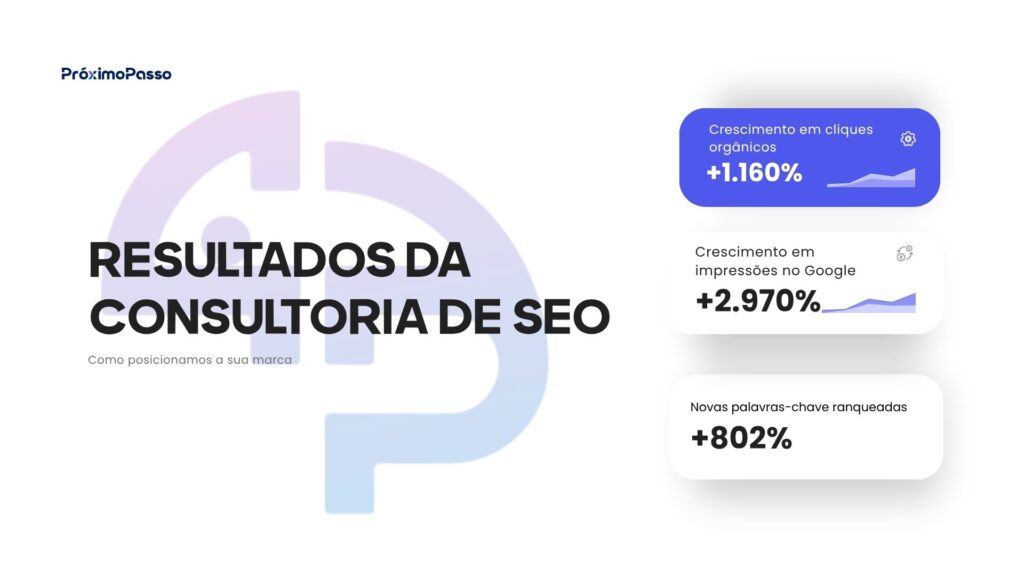
How a 22-Year-Old HVAC Company Grew Organic Clicks 1,160% With SEO and Full-Stack Development
Industry: HVAC and Air Conditioning (B2B + B2C)
Services provided: Full-Stack Development, SEO, Copywriting
Partnership start: 2023
The Challenge
The company profiled here is one of the most established players in the HVAC and air conditioning market in southern Brazil. Founded in 2002, it has built more than two decades of operation, with locations in five cities across the state of Paraná and a distribution center in Mato Grosso do Sul, plus nationwide coverage.
In 2023, the company was in the middle of a strategic transition: a full rebrand, a new visual identity, a new name. The problem was that its primary digital channel was not built to carry that evolution.
The scenario before the partnership
The previous website ran on WordPress and leaned heavily on plugins for its product catalog, portfolio, and content management. The result: slow load times, instability, and an architecture that made technical SEO effectively impossible. Organic performance was close to zero. Over a three-month window, the site pulled in just 111 organic clicks and surfaced for a total of 1,608 impressions.
To offset that organic invisibility, the company was spending around R$ 20,000 (BRL) per month on paid traffic. It worked as a short-term fix, but it created a structural dependency: the moment the spend stopped, the demand stopped with it.
The bottlenecks flagged in the audit:
• A WordPress site with an architecture unsuited to advanced technical SEO
• No pages optimized for strategic services and locations
• Zero coverage for high-intent terms such as “VRF air conditioning,” “air conditioning installation in Maringá,” or “air conditioning in Curitiba”
• The old brand identity still dominating search results, creating confusion with the new positioning
• No in-house management panel: every content update depended on third-party plugins
The Strategy
Próximo Passo did not come in with a partial fix. The audit made it clear that the problem was structural: there was no point running SEO on top of an inadequate technical foundation. The call was to rebuild everything, on purpose.
Phase 1: Diagnosis and Planning
The discovery phase confirmed that the company had real brand authority: more than 22 years of customer relationships, a portfolio spanning hospitals, industrial plants, churches, and high-end residences, and accreditation with the sector’s leading manufacturers. The problem was not a lack of credibility. It was digital invisibility. The mapping exposed clear gaps in local terms, in the VRF systems category (high ticket, fast-growing in B2B), and across every service page.
Phase 2: Conversion Infrastructure and Full-Stack Development
The decision was to drop WordPress and build a custom platform in HTML, CSS, and JavaScript, designed from scratch in Figma with an editable management panel. The client’s team could now update content, portfolio, and products with full autonomy, with no dependence on a developer or on renewing plugin licenses.
That choice delivered three concrete advantages:
• Technical performance: with no plugin overhead, the site gained real load speed, a direct ranking factor in Google
• Operational independence: a proprietary CMS, without the vulnerabilities that come with third-party plugins
• SEO-first architecture: URL structure, heading hierarchy, schema markup, and internal linking built with SEO as an engineering requirement, not a bolt-on afterthought
Phase 3: Semantic Authority, SEO, and GEO
With the technical base in place, the work shifted to progressive semantic coverage. Clusters for installation, maintenance, VRF systems, projects, and locations were mapped and covered with pages structured to answer the audience’s real questions at each stage of the buying journey.
The content was produced to be read as a trustworthy source by both Google’s algorithms and the language models that now power AI search results (GEO): clear language, explicit semantic structure, concrete data about the company, and proper entity markup.
Phase 4: Portfolio as an Authority Asset
The project portfolio was structured with individual pages per project: hospitals, churches, industrial plants, car dealerships, laboratories, and high-end residences. Real differentiators such as manufacturer accreditation, a specialized training center, and international sustainability certification were positioned as conversion elements, not just branding.
Real Results
The figures below are pulled directly from Google Search Console, comparing the last three months against the same period a year earlier.
Overview: consolidated growth
| Metric | Prior year | Last 3 months | Change |
| Organic clicks | 111 | 1,398 | +1,160% |
| Google impressions | 1,608 | 49,364 | +2,970% |
| Ranked keywords | 111 | 1,001 | +802% |
| Desktop clicks | 51 | 803 | +1,474% |
| Mobile clicks | 59 | 590 | +900% |
The desktop growth matters most for the client’s B2B profile: construction firms, architects, and installer partners search mostly on computers. A strong presence on that device means capturing the highest-average-ticket audience.
Brand terms: consolidating the rebrand
The queries below are the client’s real search terms in Portuguese, the language of its market. Every number comes straight from Search Console.
| Keyword | Prior clicks | Current clicks | Current position |
| [brand] ar condicionado | 22 | 219 | 1.5 |
| [brand] | 5 | 140 | 1.2 |
| [brand] ar condicionado maringá | 0 | 39 | 1.0 |
| [brand] ar condicionado cascavel | 0 | 12 | 1.0 |
| [brand] ar condicionado curitiba | 0 | 9 | 1.0 |
Non-brand terms: capturing new demand
| Keyword | Current clicks | Impressions | Position |
| ar condicionado maringá | 16 | 831 | 2.1 |
| ar condicionado curitiba | 4 | 706 | 2.5 |
| ar condicionado cascavel | 8 | 476 | 2.9 |
| ar condicionado em curitiba | 10 | 335 | 6.6 |
| empresa de ar condicionado maringá | 3 | 84 | 3.3 |
| empresa ar condicionado curitiba | 3 | 27 | 3.1 |
| venda de ar condicionado em curitiba | 5 | 69 | 3.1 |
| fabricação de dutos de ar condicionado | 2 | 57 | 6.4 |
| instalação de ar condicionado em maringá | 3 | 172 | 6.6 |
| ar condicionado (general term) | 3 | 1,713 | 3.6 |
VRF systems: high-ticket products on the rise
| Product page | Current clicks | Impressions | Position |
| VRF Midea V6 8HP/10HP/12HP | 13 | 1,787 | 11.6 |
| VRF Midea V8 8HP/10HP/12HP | 11 | 1,199 | 10.4 |
| Mini-VRF Midea V6 Dura | 8 | 854 | 13.1 |
| VRF service page | 9 | 2,797 | 12.0 |
The high impression volume at positions still in the 10 to 13 range signals that Google recognizes these pages as relevant and is already surfacing them for qualified searches. The trend points to a steady climb toward the first page as domain authority builds, which will convert that impression volume into high-value commercial inquiries.
Wondering if SEO would pay off in your case?
No promise of ranking first in 30 days. Tell us where you are and we will show you, with method, where organic can grow and bring your acquisition cost down.
Financial Impact and ROI Calculation
The Search Console data documents growth in visibility. The question every business owner asks is: what is all of that worth in revenue? The calculation below converts the real performance data into a financial estimate, with explicit assumptions and a transparent methodology.
Assumptions used
| Assumption | Value used | Basis |
| Average ticket (residential/commercial install) | R$ 5,000 | Industry benchmark |
| Average ticket (B2B project) | R$ 30,000 | Industry benchmark |
| Organic-visit-to-lead conversion rate | 2% | Conservative for B2B services |
| Lead-to-sale conversion rate | 20% | Benchmark for specialized services |
| Project mix | 70% B2C / 30% B2B | Estimate based on company profile |
| Monthly SEO + development investment | R$ 5,000 | Market reference for equivalent scope |
| Prior paid-traffic spend | R$ 20,000/month | Real data provided by client |
The impact that does not show up in direct ROI: reducing paid-traffic dependency
This is the most important strategic gain. The company was spending R$ 20,000 a month on paid traffic as its only source of digital demand. With structured organic growth, part of that volume starts to be covered by an owned channel, at no cost per click.
| Scenario | Monthly paid cost | Annual savings |
| Before the organic strategy | R$ 20,000 | R$ 0 (no alternative) |
| 30% reduction in dependency (12-month goal) | R$ 14,000 | R$ 72,000/year saved |
| 50% reduction in dependency (24-month goal) | R$ 10,000 | R$ 120,000/year saved |
Unlike paid traffic, where the investment has to be renewed month after month to hold the results, the organic channel built through SEO is an asset that appreciates over time. The cost per organic lead falls as traffic grows.
Expert Analysis
A 1,160% jump in organic clicks over a single comparison period does not happen by accident. It is the result of a decision most companies avoid because it feels too radical: before doing SEO, the foundation had to be rebuilt.
The most common mistake at companies with a solid track record is believing that a digital visibility problem gets solved with spot fixes: a meta description here, a keyword there. In this case, the diagnosis was clear: the problem was structural. An inadequate platform, an architecture with no SEO logic, and a total absence of semantic coverage. Running SEO on top of that structure would have meant building on a cracked foundation.
The decision to build the site from scratch, with proprietary technology and an architecture designed for performance and ranking, is what made these results possible. It is not the right answer for every case. But for a company in the middle of a rebrand, with a complex product portfolio and a need for operational autonomy, it was the decision that aligned technology, brand, and SEO in a single move.
The second decisive factor was distributed semantic coverage. The site was not built for a single term. It was built to cover the entire buyer journey, from exploratory research to the purchase decision, across every strategic city and every product category. The 1,001 unique terms drawing impressions are the measurable expression of that.
Insight for companies in the same sector
HVAC, installation, and maintenance companies that depend on paid traffic to generate leads sit in a structurally fragile position. The cost per lead on that channel climbs every quarter. Local SEO, specifically, is the biggest underused opportunity: companies with a presence in multiple cities can multiply their demand-capture surface in proportion to the number of locations they serve, at an incremental cost far below what it takes to replicate ad campaigns city by city.
About the data
The performance metrics are real and pulled directly from Google Search Console, covering January to March 2026 compared against the same period in 2025. The financial impact estimates use market benchmarks for the HVAC sector and should be read as a reference, not as a guaranteed projection. Actual revenue generated depends on variables specific to each business.
Case study produced by Próximo Passo. Sorocaba, SP, Brazil.